
How AI Tutors and WhatsApp Study Groups Are Quietly Transforming African Classrooms
Across Africa, students are turning AI tutors, WhatsApp study groups, and Telegram channels into powerful after-school classrooms. Discover how these low-cost digital tools are transforming learning in Nigeria, Kenya, Ghana, and South Africa—and what educators and parents can do to guide them safely.
How AI Tutors in African Education Are Rewriting the Classroom Playbook
You are watching a quiet revolution unfold. Across the continent, AI tutors in African education, WhatsApp study groups, and Telegram channels are turning cheap smartphones into powerful learning hubs. Instead of waiting for formal reforms, students, parents, and teachers are building their own digital support systems, one voice note and one prompt at a time.
Moreover, this shift is not driven by expensive hardware or futuristic labs. It is powered by low-cost data bundles, youth creativity, and a wave of African EdTech startups tapping into AI for homework help, exam prep, and language learning. In many schools, the most important classroom tool today is the phone in a student’s pocket.
Consequently, if you care about the future of African education, you need to understand what is happening in those WhatsApp groups, how teachers quietly use AI chatbots to draft lesson plans, and why parents now ask their children to "check with the AI" before panicking about tough assignments. This is where the next chapter of learning is being written.
Why AI Tutors in African Education Are Taking Off Now
Notably, AI in African classrooms is rising at the same time as smartphone access, youth-led innovation, and global EdTech investment are surging. Dalberg estimates that AI can ease teacher workload and improve engagement in oversized classes, a common reality across many African countries.[1] Furthermore, UNESCO and the UN highlight a fast-growing wave of African EdTech startups building AI-powered tools tailored to local languages and curricula.[4]
Additionally, global EdTech reports show that AI-powered learning tools are now central to modern education systems, from personalized chatbots to automated practice tests.[3][6] While many of these statistics come from Europe, Asia, and North America, the demand is just as strong in Lagos, Nairobi, Accra, and Johannesburg. African learners are not waiting to be "given" innovation. They are already using global tools and remixing them for local realities.
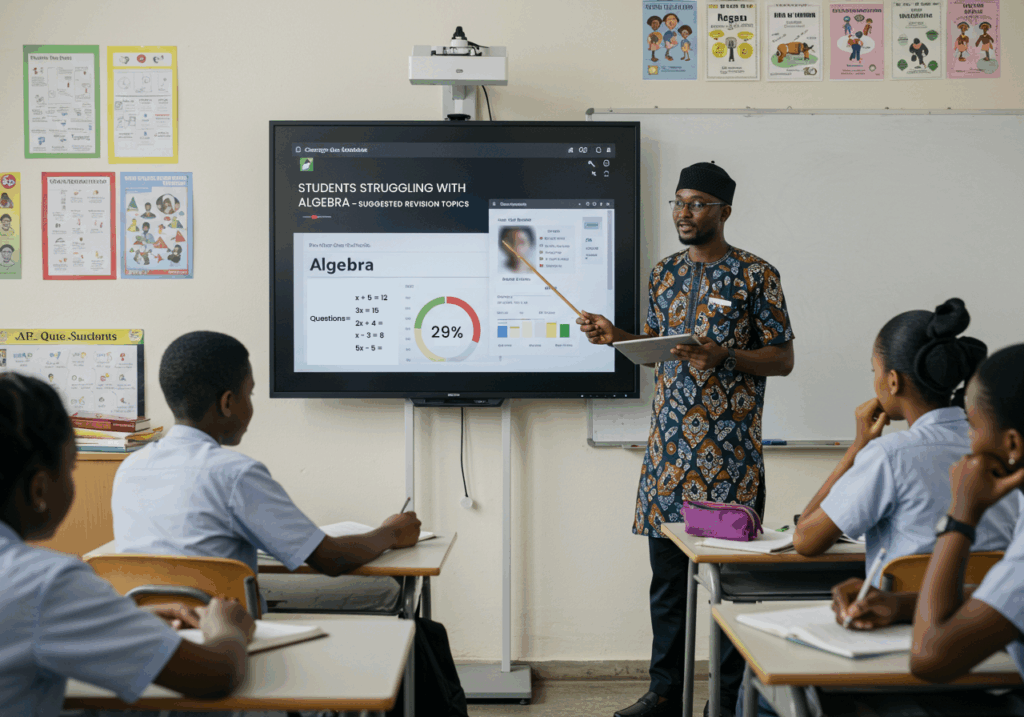
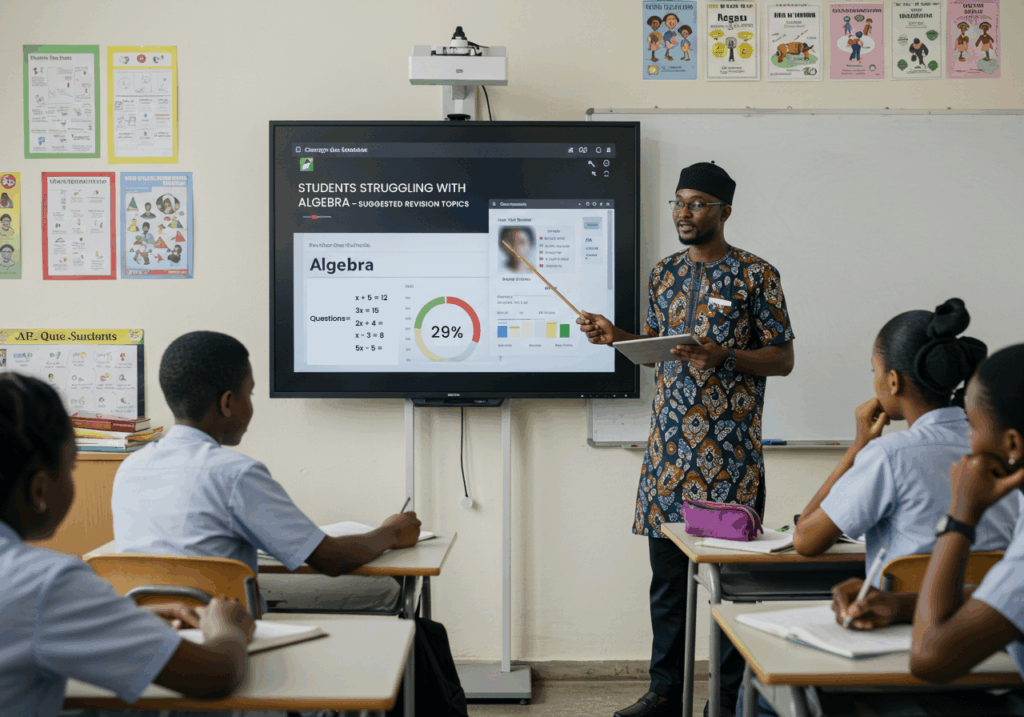
As a result, AI is not replacing teachers in African schools. Instead, it is extending their reach. In crowded classrooms, a teacher might not answer every question after class. However, a student can now open an AI chatbot on their phone, paste a math problem, and get a step-by-step explanation in seconds. That extra layer of support is changing the rhythm of learning.
The Perfect Match: Cheap Data, Smart Youth, and Mobile-First Learning
Similarly, the combination of cheaper data bundles, affordable Android devices, and youth digital fluency creates the perfect environment for AI tutors to grow. African learners already spend hours on apps like WhatsApp, Telegram, and TikTok. Therefore, using the same platforms for quick tutoring, essay drafting, or exam revision feels natural.
In addition, many African EdTech startups now build tools that run inside popular messaging apps instead of separate websites. For instance, some offer AI-powered WhatsApp bots that explain concepts in English and local languages, helping students in rural and urban schools access support with minimal friction.[4] Importantly, this approach fits Africa’s mobile-first reality, where laptops are rare but smartphones are everywhere.
Consequently, you do not need a full computer lab to tap into AI. You just need a school WhatsApp group, a responsible teacher or parent admin, and clear rules on when and how to use AI tools. That simplicity is why this transformation spreads so quickly and quietly.
Inside WhatsApp Study Groups: Africa’s New After-School Classroom
Today, if you step into a senior secondary classroom in Lagos or Nairobi, you will likely find at least one active WhatsApp or Telegram study group. Often, students themselves create these groups, then invite classmates, older siblings, or even a favorite teacher. In many cases, the group becomes a 24/7 digital classroom.
Moreover, AI now sits inside these chats. A student posts a difficult chemistry question. Another student copies it into an AI chatbot and shares the explanation back with the group. Sometimes they ask the AI to simplify the answer in pidgin, Sheng, or township slang to make it easier to understand. In effect, the group has gained a tireless, on-demand digital tutor.
Importantly, these informal "AI plus WhatsApp" classrooms help level the playing field. Students who cannot afford private lessons or extra classes still get access to step-by-step guidance, alternative explanations, and endless practice questions. However, this shift only works well when there is guidance on how to use AI responsibly and avoid over-reliance.
How Students Are Using AI, WhatsApp, and Telegram for Learning
Across Nigeria, Kenya, Ghana, and South Africa, you see similar study patterns emerging in chat groups:
- Homework help: Students snap photos of math or physics questions, ask the AI to explain, then discuss the steps together.
- Exam revision: Learners generate practice questions with AI, share them in the group, and compare answers in the chat.
- Language learning: Students ask AI to translate words, write sample essays, or correct grammar in English, French, Arabic, Kiswahili, or local languages.
- Past paper breakdowns: Groups upload past exam questions and get AI to show solution patterns and common traps.
- Career guidance: Some older students ask AI for information about scholarships, tech careers, or coding paths, then share insights with younger peers.
Furthermore, many tertiary students in universities across the continent use AI tools for research scaffolding, idea generation, and project planning. When used well, AI becomes a first draft partner, while students still verify facts and add original analysis from credible sources like academic journals and local research institutes.
Country Snapshots: How AI Tutors Are Emerging in African Classrooms
While every country is different, several common themes stand out in Nigeria, Kenya, Ghana, and South Africa. In each of these markets, local startups and creative educators are leading the way, often ahead of formal policy.
Nigeria: WhatsApp Academies and Youth-Led EdTech Hustle
In Nigeria, youth-driven innovation and massive exam pressure make AI-powered tutoring especially attractive. Many WAEC and JAMB candidates already rely on WhatsApp "academies" run by tutors who host live audio sessions, share notes, and answer questions late into the night. Now, these tutors increasingly use AI in the background to generate practice questions, rephrase explanations, or translate complex terms into simple English.
Additionally, Nigerian EdTech founders are experimenting with AI chatbots that work inside messaging apps, offering support in subjects like mathematics, English, and basic coding. According to UN reports, African entrepreneurs are rapidly building AI-enabled tools that align with national curricula and local languages.[4] Nigerian creators fit right into this trend.
Consequently, if you are a Nigerian student or parent, you probably already use at least one AI-assisted education tool, even if you do not call it that. The line between "AI tutor" and "helpful WhatsApp bot" is becoming increasingly blurred.
Kenya: Telegram Tech Communities and Coding-Focused AI Learning
Kenya’s tech-savvy youth scene and strong mobile money ecosystem create fertile soil for AI-enhanced learning. Many high school and university students join Telegram channels focused on coding, robotics, and science competitions. Inside these communities, AI plays multiple roles: debugging assistant, documentation explainer, and brainstorming partner.
Moreover, Kenyan EdTech startups and non-profits collaborate with global partners to test AI tools in classrooms, especially for STEM subjects. World Bank research on AI-enabled EdTech stresses that tools must align with local curricula and languages to work in low and middle income countries, including African contexts.[2] Kenyan innovators are applying this lesson by building solutions informed by teachers on the ground.
Therefore, if you are an educator in Kenya, you can integrate AI into a simple Telegram group without needing complex infrastructure. A few clear rules, plus a list of recommended AI tools, can transform your group into a mini digital lab.
Ghana: AI Support for Foundational Skills and Language
Ghana’s education ecosystem has long focused on improving foundational literacy and numeracy. AI now offers new ways to support that mission. Some Ghanaian teachers use AI tools to generate reading passages, comprehension questions, and simple quizzes aligned with local topics. Others ask AI to explain concepts using everyday Ghanaian examples, from tro-tro transport to local markets.
In addition, WhatsApp and Telegram groups in Ghana often mix English with local languages. Students might ask a question in Twi, then request an AI explanation in simple English. This code-switching helps learners understand complex ideas without losing cultural context. Dalberg’s analysis of AI in African education notes that AI can enhance engagement and reach students who might otherwise struggle in crowded classrooms.[1]
As a result, Ghanaian educators who embrace AI and messaging apps often see more active participation from shy students who may not speak up in class but feel comfortable typing questions after school.
South Africa: Blending Formal EdTech and Informal Chat-Based Tutoring
South Africa has one of the more mature EdTech landscapes in Africa, with established platforms, coding academies, and digital learning programs. However, the most dynamic action still happens on mobile phones, especially in WhatsApp study groups. University and high school students use AI chatbots to break down complex topics in physics, economics, and engineering.
Furthermore, South African educators and researchers are actively exploring the best ways to integrate AI in teaching while maintaining critical thinking and creativity.[7] They emphasize that AI should support, not replace, human interaction. This thinking aligns with global research that shows AI tools work best when teachers guide students on how to ask good questions, evaluate answers, and reflect on their learning.[5][8]
Consequently, South Africa offers a useful glimpse of the future for the rest of the continent: a hybrid model where formal platforms, home-grown AI tools, and informal chat-based study groups all work together.
Benefits: What AI Tutors and Chat Groups Are Getting Right
When used wisely, AI tutors in African education and WhatsApp study groups deliver several powerful benefits. These advantages matter in every classroom, but especially in contexts with large class sizes, limited textbooks, and uneven access to extra lessons.

1. Personalized Explanations in Local Contexts
Firstly, AI tools can adapt explanations to a student’s level and context. A learner who struggles with algebra can ask the AI to break down equations step by step, then ask for a simpler version again in plainer language. In many cases, they can even request examples drawn from local life, like market prices, transport fares, or football statistics.
Moreover, this personalization is hard for one teacher to provide for dozens of students within a 40-minute lesson. By offloading some practice and explanation to AI, teachers can spend more class time on deeper discussion, group work, and feedback. This aligns with global research showing that AI tutors can reduce administrative workload and free teachers to focus on interaction and mentoring.[3]
2. Constant Availability and Peer Collaboration
Secondly, AI-enhanced study groups offer learning support long after the final school bell. Students can revise at night, on weekends, or during holidays, while still getting near-instant guidance. That flexibility helps rural learners, working students, and those preparing for high-stakes exams.
Additionally, the mix of AI answers and peer discussion creates a powerful learning loop. A student might share an AI-generated explanation; another student might challenge it or ask the AI for an alternative view. This back-and-forth builds critical thinking, especially when teachers encourage students to verify answers through textbooks and trusted sources instead of accepting AI as always correct.
3. Support for Under-Resourced Schools and Parents
Thirdly, AI tutors and chat groups help fill gaps where schools or families lack resources. A parent who never studied physics can still support their child by helping them type a question into an AI tool. A teacher who teaches multiple subjects can lean on AI to generate practice questions, worksheets, or simple reading passages tailored to their class.
Furthermore, global organizations like the World Bank and UNESCO stress that AI-enabled EdTech, when designed for low-resource contexts, can help close learning gaps in low and middle income countries.[2][4] African innovators are now showing what that looks like in practice on the ground.
Risks and Challenges: What You Need to Watch Carefully
Despite the excitement, responsible use is non-negotiable. AI tutors in African education also come with real risks that you cannot ignore. If left unchecked, they can amplify misinformation, encourage cheating, or deepen digital divides.
1. Accuracy, "Hallucinations," and Over-Reliance
Global AI research shows that even advanced models still make factual mistakes, especially in math, science, or niche topics.[3] Sometimes AI confidently presents a wrong solution, a problem often called "hallucination." If students copy answers blindly, they can learn the wrong methods and lose marks in exams.
Therefore, educators must teach students to treat AI as a coach, not an answer machine. Students should learn to:
- Cross-check AI answers with textbooks, class notes, or verified online resources.
- Ask AI to show steps, not just final answers, then work through them.
- Use AI for practice and explanation, but write final answers and essays in their own words.
Additionally, parents can reinforce this message at home by asking children to explain AI-generated answers out loud, turning the tool into a prompt for conversation rather than a shortcut.
2. Privacy, Data, and Group Safety
AI tools, especially free ones, often collect user data to improve their models.[3][8] Meanwhile, WhatsApp and Telegram groups can expose students to strangers, spam, or harmful content if not managed well. In the African context, where digital literacy levels vary widely, this combination requires careful management.
Consequently, teachers and parents who manage study groups should:
- Limit group membership to known students and trusted adults.
- Set clear rules about sharing personal information and photos.
- Choose AI tools with transparent privacy policies and age-appropriate settings.
- Regularly remind students not to upload sensitive data, like ID numbers or full personal details.
Moreover, schools should develop simple digital safety guidelines tailored to their context. Even a one-page policy, shared in both English and local languages, can make a meaningful difference.
3. Inequality and the Digital Divide
AI tutors and messaging apps rely on connectivity, devices, and data. In many African communities, not every student has personal access to a smartphone or a stable connection. If schools and governments do not address this gap, AI could deepen inequality rather than reduce it.
However, there are creative solutions. Some schools share devices, organize communal revision sessions with a projector and one AI-enabled device, or schedule "AI hours" in computer labs. Governments and startups are also exploring zero-rated education platforms and low-bandwidth tools to make AI more accessible to rural learners.[2][4]
Ultimately, the goal is not to give every child the latest gadget. It is to ensure that the benefits of AI reach students in both high-income suburbs and low-income villages.
Practical Tips: How Educators Can Use AI Tutors and Chat Groups Safely
If you are a teacher, you do not need to become a programmer to start using AI responsibly. You just need a clear plan, a few ground rules, and a willingness to learn alongside your students. Here are some practical ways to get started.
Set Clear Learning Goals Before You Open the App
Firstly, decide what you want AI to help with. Do you need faster quiz creation, extra explanations for struggling students, or creative writing prompts for language lessons? When you start with a clear goal, you avoid random AI use and keep the focus on learning.
Furthermore, you can share these goals with your students. For example, you might say, "We will use AI today to create practice questions for our upcoming exam, but you will answer them without copying the AI’s solutions." That framing helps students see AI as a tool inside your strategy, not a replacement for effort.
Use AI for Preparation; Keep Assessment Human
Many teachers across the world already use AI to save time on non-core tasks, such as drafting lesson plans or creating worksheets.[3][6] In African classrooms, where teachers often handle large classes and multiple subjects, this time-saving effect is huge.

Therefore, you can:
- Ask AI to draft a lesson outline, then adapt it to your syllabus and context.
- Generate multiple-choice questions and short exercises, then check them for accuracy.
- Use AI to suggest differentiated tasks for advanced and struggling students.
However, keep actual grading and final assessment under your control. That way, you preserve academic integrity and maintain a deep understanding of your learners’ strengths and weaknesses.
Create Classroom and Group Rules for AI Use
Secondly, co-create simple rules with your students. When they help write the rules, they are more likely to respect them. You might include guidelines like:
- Do not submit AI-generated work as your own without editing and understanding it.
- Always check AI answers against class notes or trusted resources.
- Use AI to learn, not to cheat during tests or in-class assignments.
- Respect privacy and do not share personal details in study groups.
Additionally, you can revisit these rules each term as tools evolve and new situations arise. This helps build students’ AI literacy, a skill they will need in almost every future career.
Blend AI with Culturally Relevant Content
AI models often draw from global content that may not reflect African realities. You can counter this by asking AI to incorporate local examples, proverbs, and case studies into explanations. For instance, you might request a business studies example based on a local market in Kumasi or a township spaza shop in Cape Town.
Moreover, you can encourage students to challenge AI when it misses context. Ask them, "How would you adapt this example to fit our community?" That simple question turns AI from a static textbook into a starting point for critical and culturally grounded thinking.
Guidance for Parents: Turning Phones into Learning Partners
If you are a parent or guardian, you might worry that your child’s phone is only a distraction. However, with guidance, that same device can become a portable tutor, language coach, and revision partner. The key is to stay involved, even if you do not fully understand the technology.
Ask Your Child to Teach You How They Use AI
Firstly, flip the script. Instead of telling your child "Do not use AI," ask them to show you how they already use it. Let them demonstrate how they ask homework questions, write drafts, or check grammar. This approach gives you insight into their habits and opens the door to better guidance.
Additionally, you can ask questions like:
- "How do you know this AI answer is correct?"
- "Can you show me the steps it used?"
- "What would your teacher say about this explanation?"
Moreover, this style of conversation builds digital confidence and keeps learning a shared family project, not a secret activity hidden behind a screen.
Set Time and Place Rules, Not Just Bans
Secondly, instead of banning phones or AI outright, set clear boundaries. For example, you might allow AI use for revision between 5 pm and 7 pm in a shared space like the living room, with the TV off. During this time, encourage your child to save tricky questions to discuss with you or their teacher.
Furthermore, you can create a short list of approved tools and group admins that you trust. If you help manage a class WhatsApp group, work with the teacher to remove spam, keep conversations focused, and protect younger learners from harmful content.
Where African Startups, Creators, and EdTech Influencers Fit In
Across the continent, a new wave of African tech founders, content creators, and education influencers are shaping how AI shows up in classrooms and study groups. Many of them share bite-sized lessons on TikTok, Instagram, and YouTube, blending pop culture with serious learning.
Moreover, these creators often act as the real bridge between AI technology and everyday learners. A short explainer video in Nigerian pidgin or Kenyan Sheng can demystify AI faster than any long policy document. As AI grows, African voices must lead the conversation about ethics, culture, and relevance.
If you want to stay ahead of this trend, you can explore more African innovation stories on Technology, discover youth-focused insights on Africa News, or dive into creative culture on Culture & Lifestyle. These spaces highlight how tech, music, fashion, and education intersect in fresh, optimistic ways.
Global Insights You Can Apply Locally
To use AI well in African classrooms, it helps to learn from global research and adapt it to local needs. Reports from organizations like the World Bank emphasize that AI-enabled EdTech must be equitable, collaborative, and tailored to local realities.[2] UN News highlights how African governments and entrepreneurs are already moving in this direction.[4]
Additionally, analysis from EdTech experts shows that generative AI tutors are most effective when they encourage active learning, not passive copying.[3][5] Students learn more when they ask follow-up questions, explain answers in their own words, and use AI as a partner in problem-solving.
If you want to dig deeper into AI and teaching best practices, you can read more about responsible AI use in education from institutions like Ohio State University, which offers clear guidance for educators globally.[8]
Explore More on Topping Africa
Ready to explore how AI, youth culture, and African innovation connect beyond the classroom? Here are a few Topping Africa sections to dive into next. Read more, share your thoughts, and stay ahead of the curve.
- Technology – Discover African startups, AI breakthroughs, and digital tools reshaping work, school, and everyday life.
- Business & Economy – Explore how EdTech and AI are powering new business models and job opportunities.
- Opinion & Editorial – Engage with bold perspectives on education, youth, and the future of innovation on the continent.
Additionally, you can discover more stories on health, well-being, and the impact of tech on daily life in our Health & Wellness section. Do not just consume the future of African education from a distance – be part of the conversation, share your experiences, and help shape what comes next.
Final Thoughts: Turning Quiet Experiments into Lasting Transformation
AI tutors in African education, WhatsApp study groups, and Telegram channels might feel like small, informal experiments today. However, together they represent one of the most important shifts in how African students learn, revise, and dream about their futures. From Lagos to Nairobi, Accra to Johannesburg, young people are proving that world-class learning can start on a low-cost smartphone.
If you are an educator, parent, startup founder, or student, this is your moment to lean in. Set smart rules. Choose tools that respect privacy. Blend AI with local culture, language, and creativity. Most importantly, keep human relationships at the center. When you do that, AI stops being a threat and becomes what it should be: a powerful partner in building the confident, skilled, and imaginative African learners the future demands.
Ultimately, the question is not whether AI will shape African classrooms. It already is. The real question is how you will guide that change. Will you explore, adapt, and lead – or watch from the sidelines? The next move is yours. Share your thoughts, leave a comment in your circles, and keep the conversation alive.

Staff
Contributing writer at Topping Africa.
0 Comments
No comments yet. Be the first to share your thoughts!